

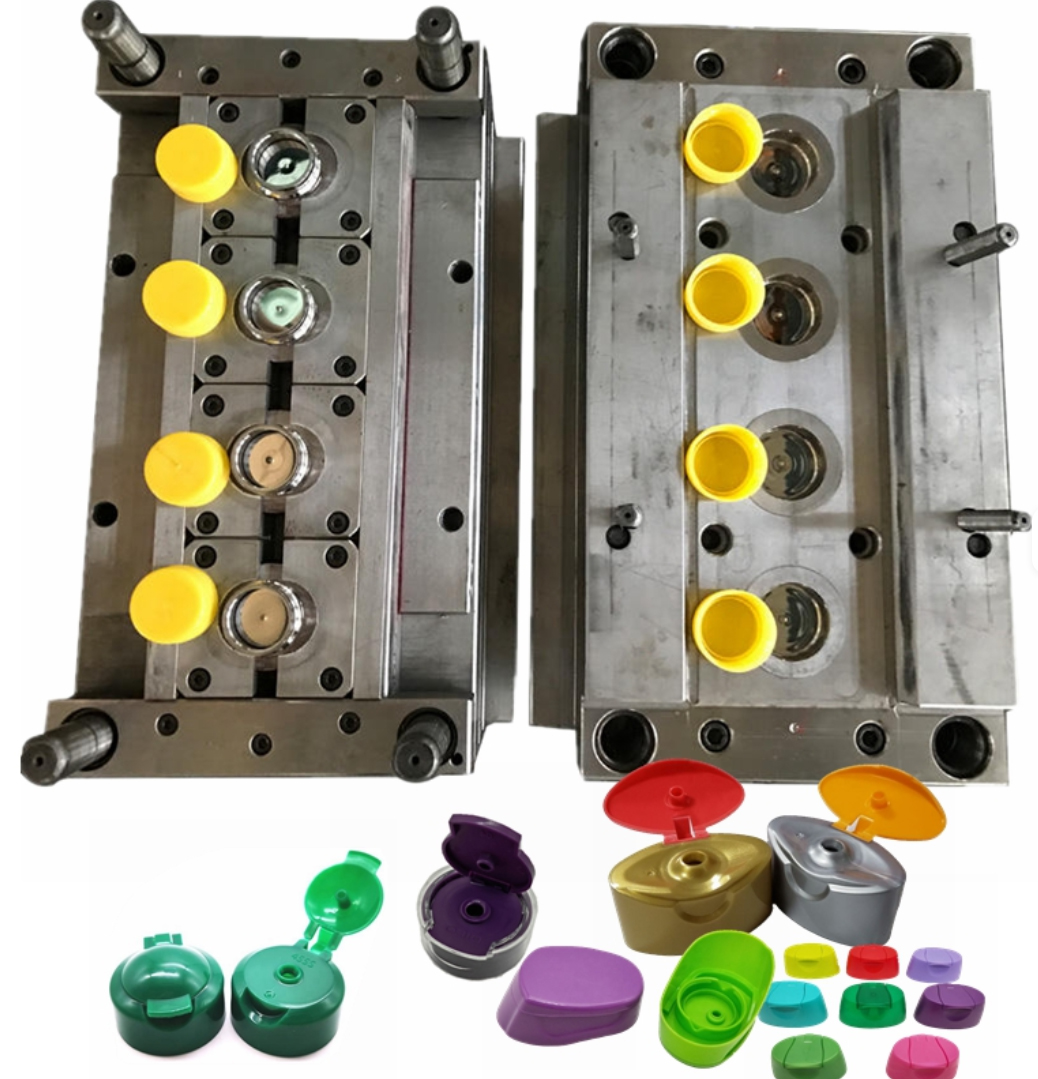
OEM Customization Bottle Lid Mold Shampoo Lid Mold Household Products Flap Plastic Mold
Overview: What Are These Molds?
The keyword string "OEM Customization Bottle Lid Mold Shampoo Lid Mold Household Products Flap Plastic Mold" describes a highly specialized service: the design and manufacturing of custom injection molds used to produce specific types of plastic lids.
In simple terms:
It's a "Master Template": The mold is a hardened steel or aluminum block with a precise cavity. When molten plastic is injected into it, it cools and forms a lid that is an exact replica of that cavity.
End Product: The lids produced are typically flip-top or flap lids (the "Flap Plastic Mold" part) used for shampoo bottles, condiment bottles, lotions, and various other household products.
The key value proposition here is OEM Customization – creating a unique lid design tailored to a brand's specific needs.
Key Features and Technical Specifications
A manufacturer offering this service would typically highlight the following aspects:
1. Mold Design & Engineering
CAD/CAM/CAE Integration: Use of advanced software (e.g., SolidWorks, UG/NX) for 3D design, simulation of plastic flow (to prevent defects), and computer-aided manufacturing.
Customizable Features: Every aspect can be tailored:
Size & Shape: Diameter, height, and overall form factor.
Closure Mechanism: Type of hinge (living hinge, snap-in hinge), latch design (push-pull, snap closure).
Spout Design: Size and shape of the opening.
Branding Elements: Embossed or debossed logos, text, or patterns on the lid.
Thread Design: For secure attachment to the bottle.
Material Flow Analysis: Pre-production simulation to ensure perfect filling and minimize issues like air traps or weld lines.
2. Mold Manufacturing & Quality
Mold Base Material: High-quality steel (e.g., P20, H13, S136 for corrosion resistance) or aluminum for shorter runs/prototypes.
Precision Machining: Utilizing CNC milling, EDM (Electrical Discharge Machining), and deep-hole drilling to create complex features with high accuracy (tolerances within ±0.01mm).
Surface Finishing: Polishing, texturing (e.g., matte, glossy, grained), and coating (e.g., chrome plating for wear resistance) to achieve the desired finish on the final plastic lid.
Standard Components: Use of high-quality, standardized ejector pins, guide pillars, and hot runner systems (if applicable) for reliability.
3. End-Product (Lid) Specifications
Compatible Plastics: Designed for common injection molding materials like Polypropylene (PP - most common for living hinges), Polyethylene (PE), ABS, etc.
Functionality: The produced lid will have:
Durable Hinge: Designed for thousands of open/close cycles without breaking.
Secure Seal: Often includes a soft seal (TPE/TPR) insert mold or a precise snap-fit to prevent leaks.
User-Friendly Operation: Easy to open and close with one hand.
Common Applications
The lids produced from these molds are used in a wide range of Household Products:
Personal Care: Shampoo, conditioner, body wash, lotion, liquid soap bottles.
Food & Beverage: Condiment bottles (ketchup, mustard), sports drink bottles, honey dispensers.
Home Cleaning: Detergent bottles, disinfectant sprays, cleaning solution containers.
Pharmaceuticals: Some medicine or vitamin bottles.
The OEM Customization Process (Step-by-Step)
For a client (the brand owner), the process typically works like this:
Inquiry & Concept: The client provides a concept sketch, a sample, or a 3D model of their desired lid.
Design & Quotation: The mold maker engineers the lid and the mold, then provides a detailed quote including mold cost, unit price, and lead time.
Design Finalization: Both parties agree on the final design (2D drawings and 3D files).
Mold Manufacturing: The mold maker machines, assembles, and tests the mold.
Sample Approval (T1 Samples): The first samples from the new mold are sent to the client for approval of fit, function, and aesthetics.
Mass Production: Once the samples are approved, mass production of the plastic lids begins.
Delivery & Support: Finished lids are delivered, and the mold maker provides ongoing maintenance support for the mold.
Why Choose a Professional OEM Mold Maker?
Expertise in DFM (Design for Manufacturability): They can advise on design changes to make the lid easier and cheaper to produce without compromising function.
Quality and Consistency: High-precision molds produce millions of identical, high-quality lids.
Cost-Effectiveness: A well-made mold reduces scrap rates and downtime, lowering the long-term cost per lid.
Innovation: Experience with the latest technologies (e.g., stack molds, multi-cavity molds) to maximize efficiency.